Validation
What the port reproduces, measured against MATLAB-written output — and how each claim is established. The per-flight figures were measured with the v3.1.4 port, which reproduced the archived products and is not part of this package.
Cite SODA-2 as: Aaron Bansemer. (2026). abansemer/soda2: v2.26.0 (Version v2.26.0) [Computer software]. Zenodo. https://doi.org/10.5281/zenodo.18331418
| Flights validated (v3.1.4 port) | 15 — 6 of 6 held for 2016, and 9 of the 2017 flights with raw input |
| Exact | 10 — 2017-08-24 (43,416 / 43,416 cells), 2017-09-02 (37,541 / 37,541), 2017-08-13 (33,027 / 33,027), 2017-08-21 (15,953 / 15,953), 2017-08-28 (12,786 / 12,786), 09/10 (5,064 / 5,064), 2017-08-15 (4,810 / 4,810), 2017-08-18 (1,529 / 1,529), 2017-08-12 (1,416 / 1,416) and 09/25 (160 / 160) |
| Worst | 2017-08-17, 99.63 % (268 / 269 — one open cell, not yet root-caused) |
| Differing cells, 2016 | 48 — and none has both products holding a disagreeing count |
| Headline denominator | non-zero cells in bins 6+ |
| What "exactly" covers | two variables of the combined 2D-S product, Counts and Size Distribution cm-3, in size bins 6 and above, over every second both products hold. A cell is counted when either product holds a non-zero value there, and exactly means every counted cell is equal, with no tolerance. Outside the claim: bins 1-5, seconds only one product holds (reported per flight as uncovered), and the product's other variables |
See also Glossary — what a cell, a bin and the four denominators are; the numbers above are meaningless without it.
The evidence ladder
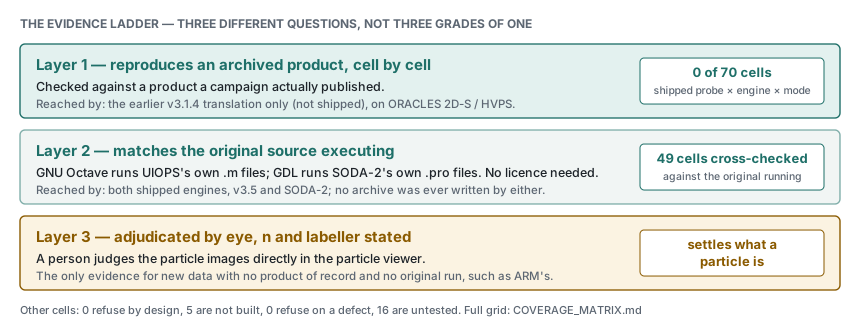
Every validation claim rests on one of three kinds of evidence, not three grades of the same thing — the three questions above. Layer 1 was reached by an earlier v3.1.4 translation (not shipped), on ORACLES; none of the shipped engines' 70 coverage-matrix cells reaches it, and every per-flight figure on this page belongs to that earlier translation.
Layer 2 is not a weaker layer 1: for both shipped engines it is the only question answerable, because no archived product was ever written by v3.5 or by this SODA-2 revision. Layer 1 is the per-flight tables below; layer 2 is "The v3.5 port's own validation" and the SODA-2 GDL checks; layer 3 is "Layer 3: adjudicated by eye" below.
The reproduction holds outside 2016
The configuration was established on 2016, so a second year tests it rather than fits it. 2017-08-13, the first flight put to it, reproduces its archived product's Counts and Size Distribution cm-3 exactly in every non-zero cell of bins 6+ over the 33,187 seconds both hold:
| non-zero cells, bins 6+ | 33,027 / 33,027 = 100.0000 % |
| non-zero cells, all 128 bins | 53,454 / 53,454 = 100.0000 % |
| both-present cells, bins 6+ | 1,170,468 / 1,170,468 = 100.0000 % |
| differing cells, every class | 0 |
Counts total, ours vs archive | 15,987,236 vs 15,987,236 |
2017-08-24 reproduces a larger denominator, 43,416 / 43,416. Both raw files entered both combines (files_stitched = 2 on each side), and both sd inputs carry .call stamps recording the ORACLES production configuration.
7 seconds of the reproduction are absent from the product and 0 of the product's are absent from the reproduction: the archived axis starts at the flight's summary timestamp, a trim that removes no shared second.
The second 2017 flight, 2017-08-15, is exact too, over 33,484 shared seconds:
| non-zero cells, bins 6+ | 4,810 / 4,810 = 100.0000 % |
| non-zero cells, all 128 bins | 20,278 / 20,278 = 100.0000 % |
| differing cells, every class | 0 |
both-present Counts, ours vs archive | 3,808,439 vs 3,808,439 |
Two qualifiers, both measured. 1,384 product seconds are uncovered, because the flight's first raw file was never delivered — the product is named …072145 and the earliest raw held is …074449, and 07:44:49 − 07:21:45 is 1,384 s exactly. Those seconds hold zero archive particles. And 40 particles of the reproduction sit in 640 cells the archive holds as fill, with 4 of the archive's where the reproduction is fill; the both-present rule excludes both classes, so the raw totals differ by 36 while every comparable cell agrees.
A third exact 2017 flight, 2017-08-12 (2 raw files stitched, 30,503 shared seconds): 1,416 / 1,416 non-zero used-bin cells, 11,027 / 11,027 over all 128 bins, zero differing cells.
The fourth first-batch flight, 2017-08-17, is the one open result: 268 / 269 non-zero used-bin cells (99.63 %) — one product-only cell, bin 6, second 16:22:35, not yet root-caused. Its raw and intermediates are kept until that cell is explained.
Nine 2017 flights hold both raw input and an archived product, and eight of them reproduce theirs exactly on both compared variables — 2017-08-18 (1,529 / 1,529 non-zero cells in bins 6+ over 21,351 shared seconds), 08-21, 08-24, 08-28 and 09-02 among them.
Two further 2017 flights cannot be adjudicated. 2017-08-19 has complete raw for both probes but no archived product of any date. 2017-08-31 has both, but its archived product and the reproduction each stitch a different raw file — the start times differ by exactly the coverage gap the comparison reports, and no raw file matching the archive's start is held. Compared anyway it agrees on under half its non-zero used-bin cells, a figure about two recordings rather than two implementations. Every flight counted above first passed the opposite test: the archived product's count of stitched files matches the reproduction's and the raw held.
Validation needs no MATLAB. It is three layers:
- Reference pair (authoritative). Raw files together with the processed output a MATLAB run produced from them. The pairs held here are listed in Conventions and terms; they are not redistributable, and adding a campaign or probe means adding a pair, not changing the pipeline.
- Differential oracle. GNU Octave runs the original
.mfiles unmodified and the port is asserted against their real output — including whole-file oracles forimgProc_smandsizeDist(not distributed), and the threeCGAL_*MEX routines compiled from source. - Documented semantics with pinned tests where neither reaches.
These describe the earlier v3.1.4 translation, which every per-flight figure on this page measures. The two engines shipped here (Index), one UIOOPS engine and one SODA-2 engine, stand on fewer. The v3.5 port has no layer 1 and never will, because no archived campaign product was produced by v3.5, so its results are asserted against Octave runs of v3.5's own sources — deliberately not against the v3.1.4 port's output, which would be circular: both ports come from the same reading and share many imports. A real axis defect in the v3.5 port passed its own fixture test for a day, because the test helper and the port shared one misreading of the C++ and every fixture record was square, so the axis convention — the whole subject of v3.5's change to that file — was never exercised. A bank of 60 non-square records fed from the real compiled MEX caught it: two sides from different places. See The v3.5 port's own validation below. The SODA-2 port's layer 2 is GDL — GNU Data Language runs SODA-2's unmodified .pro sources as Octave runs UIOOPS's .m files (the real-file GDL reference outputs are not distributed; those on synthetic inputs are), so no IDL licence is needed. Neither port contributes a number to the reproduction claim above.
Current result
The port's reject stage re-runs on the real image of every particle in a second, then sizeDist's area-ratio and inter-arrival rejections, binned and compared bin by bin against the product's Counts, on seconds sampled from the product in each cloud regime.
| Flight | File | Seconds | Result |
|---|---|---|---|
| 09/06 | 064403 (whole file) | 3,854 | 493,312 / 493,312 cells of Size Distribution and Counts, under the stock reject thresholds |
| 09/06 | 075333 (dense, whole file) | 7,534 | 100.0000 % — every non-zero used-bin cell of both variables, every second, every cloud regime |
| 09/06 | 104932 (dense, whole file) | 7,475 | 100.0000 % in the used bins; 99.98 % over all 128 bins (three single particles in bins 1–2, cause identified below) |
| 09/06 | 095907 (whole file) | 3,025 | exact except two seconds (one instance of the duplicate TAS-second particle loss), worth 6 used-bin particles of 18,077 |
| 09/10 | 071623, 102201, 124240, 102921 | whole flight | the flight combine below is the result of record — all four files validated whole |
Two complete flights, end to end
The per-file table is diagnostic; the acceptance gate is the flight combine, the only comparison whose two sides are built from the same inputs.
Flight 09/10 — exact in every used bin, with the stuck-diode correction on
Four raw files, 29,574 seconds. This result requires --diode-corrected: two files carry a confirmed stuck diode (base160910071623 diode 77, base160910124240 diode 95), re-illuminated only under that flag, and the product's .call sidecar records shadow_diode for those stems. Without it the four files reproduce 5,057 / 5,069 used-bin cells (99.7633 %), all 12 differing cells inside those two files.
| ours / product | ||
|---|---|---|
| non-zero used-bin cells | 5,064 / 5,064 | 100.0000 % |
| both-present used-bin cells | 2,521,746 / 2,521,746 | 100.0000 % |
| seconds exact | 29,476 / 29,574 | |
| sparse regime, used bins | 997 / 997 | 100.0 % |
| moderate regime, used bins | 6,654 / 6,654 | 100.0 % |
| dense regime, used bins | 10,000 / 10,000 | 100.0 % |
Identical on both Size Distribution and Counts, with no second present in one product and absent from the other. Every difference on the flight lies in bins 1–5, which the size distributions do not use — the same place the duplicate TAS-second particle loss, the dropped final raw record and the noisy-diode masks all land. The whole-flight used-bin excess is 14 particles, all in seconds the product records as empty.
Flight 09/06
Five raw files, 28,815 seconds:
| ours / product | ||
|---|---|---|
| non-zero used-bin cells | 31,303 / 31,314 | 99.9649 % |
| seconds exact | 28,806 / 28,815 | |
| sparse regime | 44,172 / 44,175 | 100.0 % |
| moderate regime | 2,082,821 / 2,082,821 | 100.0 % |
| dense regime | 34,176,689 / 34,185,949 | 100.0 % |
| used-bin particles | 233,052 / 233,058 | 6 apart |
The residual is six particles across a whole flight, from the duplicate TAS-second particle loss described below.
The figures above use the stock reject profile for the flight's first file and the production profile for the other four — what the archived product turns out to contain. All five under the production profile gives 99.834 %; that difference is the two-configuration finding, measured at flight scale.
A file's first second can belong to the previous raw file, so scoring one file alone against a whole-flight product attributes those particles nowhere — hence the combine is the gate.
The one difference over all bins is a UIOOPS behaviour the port reproduces deliberately: when a file's true-airspeed grid holds two entries for the same second, every particle in that second is discarded, by the original as by the port, and the archived products show the same loss. See the findings (duplicated airspeed seconds).
Below the size-bin comparison, two independent checks: a 128-element diode-statistics array MATLAB wrote in 2017 is reproduced bit-identical on all 128 (raw decode, channel routing and framing at once), and over 4,110 seconds of a real flight 24 of 25 imgProc variables are bit-identical across 5.3 million values — the 25th within 2.1e-15, because Octave's mean is compensated and MATLAB's is not.
How agreement is counted
A single percentage is meaningless without saying which cells it counts, so validate_combined_product.py always prints both denominators — cells both files populate (which includes agreement about emptiness) and cells where at least one side is non-zero — and states how much of the looser one is 0 == 0. The two definitions are in Conventions and terms. It exits 1 when any non-zero cell in the used bins disagrees and 0 only when all agree; --report-only prints the comparison and exits 0.
On a file that agrees completely both figures are 100 %. Both are reported because a single figure has misled here twice — once by counting NaN == NaN as agreement, once by mixing the two conventions between documents.
A cell-by-cell reproduction report. arrayprobe reproduce-report <product> <archived> [--out FILE] [--json FILE] compares every variable two netCDF products share, cell by cell, and reports for each the cells compared, the exact matches, the largest absolute and relative residual and every differing cell, with the engine and .call stamp of each file. It reads both files and writes only --out and --json (the Markdown report goes to the terminal without --out). Exit 0 when every shared cell is exact, 1 otherwise.
Count closure. arrayprobe check-counts SD PROC reconciles the binned counts of a size-distribution file with the accepted particles of its particle file, second by second, and lists each excluded particle with its cause; the probe's own housekeeping total is reported as not available until a reader exposes it. Exit 0 when every second closes exactly, 1 otherwise.
One finding about the reference itself
Stated as measurement: the same archived product file is reproduced by two different reject configurations in two time segments — its 064403 segment only by rej_hollow = 1, every other decoded file on both flights only by rej_hollow = 0. The port reproduces both; which one a user wants is a profile choice. Whether the archive was assembled from passes on either side of a 2017 edit is for its processing records to settle.
Why two version numbers, and why that is not a contradiction
They answer different questions.
The findings about UIOOPS are fixed in the v3.5 engine (where the developers addressed them) and in the opt-in enhancements (where they did not).
Findings about UIOOPS are anchored on v3.5, the current release, because a defect reported against a version nobody runs helps nobody. Every finding therefore carries a version axis: fixed in v3.5, still present, transfers verbatim (the file is byte-identical between the two), or variant-only — describing a modified copy of the UIOOPS MATLAB code, with its own thresholds, that one campaign's processing ran, rather than UIOOPS as released.
17 of 24 shared files (classified per module in uiops.CATALOGUE) are byte-identical between the two releases, so findings in them transfer with their line numbers intact. One qualifier is easy to lose and matters — dropsize.m is byte-identical across all 16 releases but is called by no version from v3.3 onward. Identical is not the same as live.
Full treatment: Conventions and Findings.
The v3.5 port's own validation
No figure in this section belongs to the reproduction claim, and none is evidence about v3.1.4.
The v3.5 port (arrayprobe_uiops) is asserted at every stage against GNU Octave running v3.5's own vendored sources, never against the v3.1.4 port. End to end, the port is run for each of three whole-program Octave reference outputs and every variable and every attribute is diffed. The imgProc_sm reference output is distributed; the sizeDist and combine reference outputs are cut from campaign data and are not, so those tests skip. STOCK_V35, a fourth fidelity profile, cites every field to v3.5's source, checked against an Octave parse ([fidelity].profile = "stock-v3.5").
| Configuration | Result |
|---|---|
| Stock v3.5 reject thresholds | 0 disagreeing items |
| ORACLES-production reject thresholds | 0 disagreeing items |
| The new habit scheme (Schima et al. 2024) | 0 disagreeing items |
Each reference output is a run of the unmodified vendored imgProc_sm.m over 6,819 real ORACLES 2016 2D-S particles, through the real CGAL_minR MEX compiled from source — not a shim — across 40 variables. The three reference outputs are tracked in the repository, so the comparison is reproducible from a fresh clone.
Why three configurations rather than one. The stock and ORACLES-production runs disagree with each other on image_auto_reject for 2,945 of the 6,819 particles, so a port that hard-coded one reject configuration would fail the other reference output by 43 % of its particles.
What this does not establish.
- There is no layer 1 for v3.5 and there never will be. No archived campaign product was produced by v3.5. A v3.5 number is layer-2 evidence, permanently.
- One routine agrees within a tolerance rather than exactly: the ellipse fit (
CGAL_EllipseSize.cpp,iRectEllipse=1), checked against the real binary compiled under Octave — axes and centre within 1e-2, angle within 1e-3. The bound and why it cannot be tighter are in Known gaps rather than folded into the table above. - The reference outputs' decoded input is campaign data and does not travel (774 MB), so the whole-program reference output check is a tool, not a test that would skip everywhere but here. a test in the development suite asserts the three reference outputs are present, git-tracked and match their SHA-256 digests, with no
skipUnless, so a fresh clone that cannot see them fails loudly.
A self-check, independent of any reference product
arrayprobe.timing_closure checks whether the probe's own two clocks agree with each other, on any file, with no reference product. McFarquhar et al. (2017, ch. 11, p. 11.20): "checks should ensure that the sum of particle interarrival times matches the record time." For a 2D-S/HVPS file, the particle-frame clock's span (Time_in_seconds[-1] - Time_in_seconds[0], in the proc file) is compared against the independent housekeeping wall-clock span between the decoded file's first and last record.
# Linux / macOS: .venv/bin/python
.venv/Scripts/python.exe -m arrayprobe validate timing-closure decoded.H.nc proc.nc
This tool reports, it does not verdict — no published tolerance exists for how close the two clocks should agree, so it prints both spans, their difference and their ratio, as compare_nc.py reports tolerance-classed differences without a pass/fail line. Run once, while the tool was being built, on one ORACLES 2016-09-06 HVPS file (base160906064343, decoded with the 2D-S reader; particle clock from a proc file written by the v3.1.4 port) that is not public, the two clocks disagreed by roughly 8× (v3.1.4-port proc file against the decoded file's housekeeping clock): a ~59-minute particle-clock span against a ~7.9-hour housekeeping span, the housekeeping one matching the flight's length. The cause is unexplained and the run has not been repeated; it is recorded as a measurement, not a defect claim, beside the HVPS count disagreement in Known gaps.
Layer 3: adjudicated by eye
A person adjudicates particle images where no archived product (the file the campaign served) exists, using the triage labelling tool.
Layer 3, continued: the hollow-rejection threshold pass
A second eye-adjudication pass settled two questions whose ground truth is only in the images. The package author labelled 480 particles across 16 cells in two rounds on CIP particle images (a label is engine-independent; which engine's run offered the particles is not recorded here), through the triage labelling tool (arrayprobe.triage_server and the gallery).
- Where the hollow-rejection test flips from correct to harmful. The estimate is ~155 µm — a best estimate, not a boundary: the Wilson 95 % intervals overlap, 45 % [31, 60] below the flip against 60 % [45, 74] above it, so the sides are not yet distinguishable at this n; a sharper crossover needs more labels.
- Whether the 55–105 µm bin holds real particles even among those both configurations accept. It does, at 32 % real, Wilson 95 % [17, 52] — agreement between configurations is not correctness.
What this licenses. Adjudication by eye settles what a particle is; it validates no pipeline against an archived product, of which there is none here. It gives a best-estimate crossover for the hollow-rejection threshold and a real-fraction for one bin, and licenses no change to any gate, threshold or default on its own. Labeller: the package author, the only labeller to date; no inter-labeller agreement number exists.
"But Octave isn't MATLAB"
Correct: MATLAB-written output of record is the acceptance oracle, Octave only the development one. The arithmetic is overwhelmingly IEEE-754 double, where conforming implementations agree bit-for-bit; integer saturation and promotion, the one implementation-defined area, was measured and is pinned by tests; and every input bank and reference output is committed, so anyone with a licence can re-run the originals and diff. Full argument: docs/developer/OCTAVE_AS_ORACLE.md.